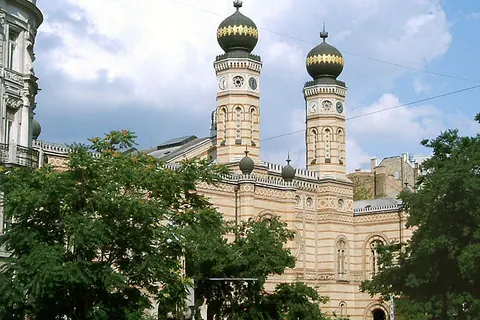
The Dohány Street Synagogue, also known as the Great Synagogue or Tabakgasse Synagogue, is a Neolog Jewish congregation and synagogue, located on Dohány Street in Erzsébetváros of Budapest, Hungary. It is the largest synagogue in Europe, seating 3,000 people, and is a centre of Neolog Judaism. The congregation worships in the Ashkenazi rite.
The synagogue was built between 1854 and 1859 in the Moorish Revival and Romantic Historicist styles, with the decoration based chiefly on Islamic architecture from North Africa and medieval Spain. The synagogue’s Viennese architect, Ludwig Förster, believed that no distinctively Jewish architecture could be identified, and thus chose "architectural forms that have been used by oriental ethnic groups that are related to the Israelite people, and in particular the Arabs". The interior design is partly by Frigyes Feszl.
The Dohány Street Synagogue complex consists of the Great Synagogue, the Heroes’ Temple, a graveyard, a memorial, and the Hungarian Jewish Museum and Archives, the latter built on the site of the house where Theodor Herzl was born. Dohány Street was the border of the Budapest Ghetto during the Holocaust.
Sources
- Wikipédia (fr) : Grande synagogue de Budapest
- Wikipedia (en): Dohány Street Synagogue
- Wikidata: Q754397
Text: introduction of the Wikipedia article Dohány Street Synagogue, under the CC BY-SA 4.0 licence (authors: article history). Facts: Wikidata (CC0). Coordinates: Wikidata, map background © OpenStreetMap contributors.