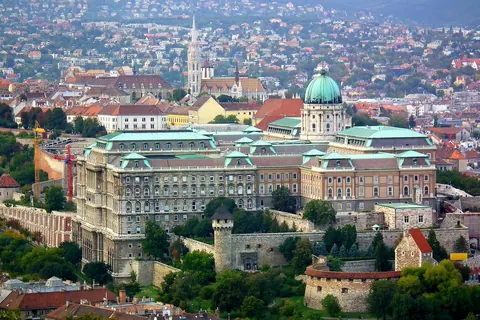
Buda Castle, formerly also called the Royal Palace and the Royal Castle, is the historical castle and palace complex of the Hungarian kings in Budapest. First completed in 1265, the Baroque palace that occupies most of the site today was built between 1749 and 1769, severely damaged during the Siege of Budapest in World War II, and rebuilt in a simplified Baroque style during the state communist era. Presently, it houses the Hungarian National Gallery, the Budapest Historical Museum, and the National Széchényi Library.
The palace complex sits on the southern tip of Castle Hill. Its defensive walls extend to surround the entire Castle Quarter neighborhood to its north, which is well known for its medieval, Baroque, and neoclassical houses, churches, and other monuments. Several prominent government buildings, including Sándor Palace and the Carmelite Monastery of Buda, are located in the Castle Quarter. Locally, this neighborhood and the palace are collectively called a Vár.
Castle Hill is linked to Clark Ádám Square and the Széchenyi Chain Bridge by the Castle Hill Funicular. The Castle Quarter falls within the part of Budapest that UNESCO declared a World Heritage Site in 1987.
Sources
Text: introduction of the Wikipedia article Buda Castle, under the CC BY-SA 4.0 licence (authors: article history). Facts: Wikidata (CC0). Coordinates: Wikidata, map background © OpenStreetMap contributors.